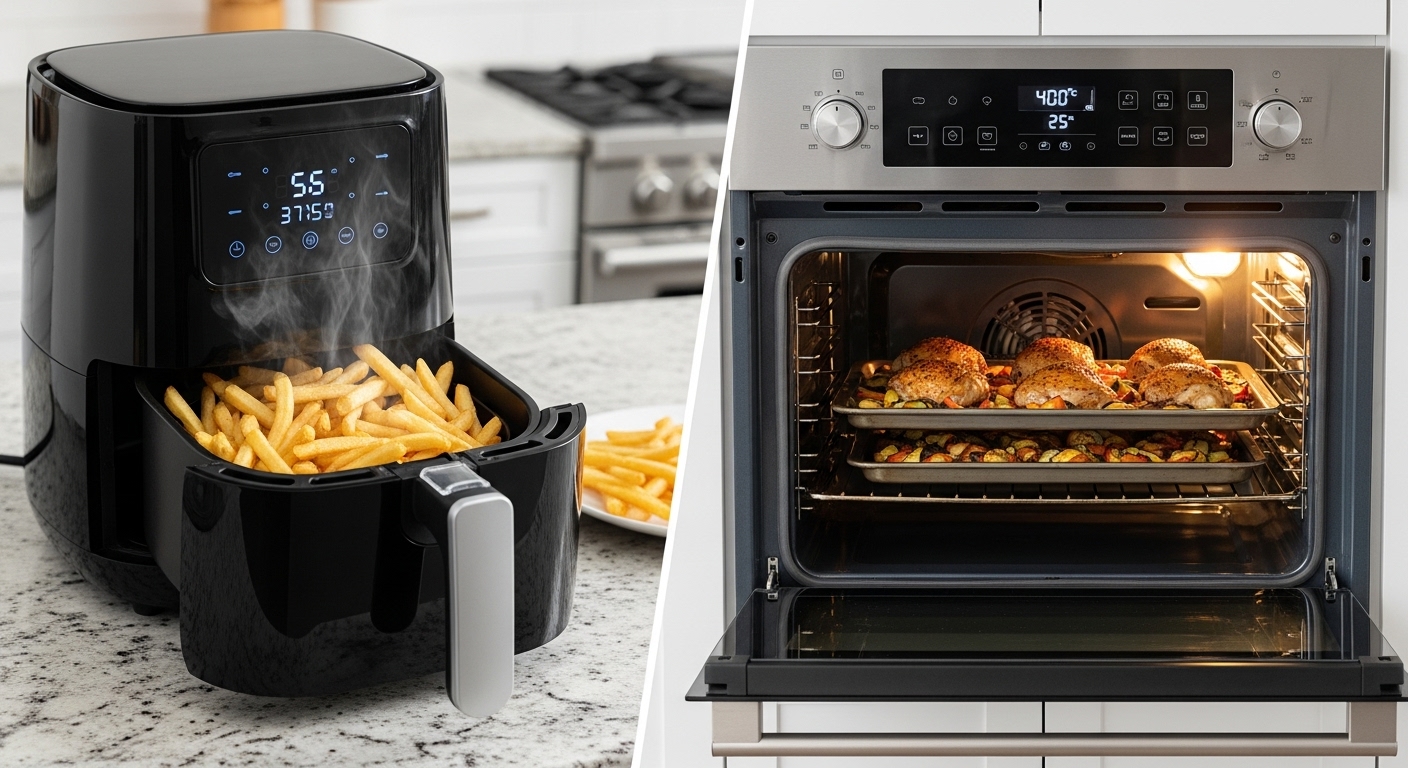
If you’re trying to simplify a small kitchen, the goal isn’t to buy more gadgets—it’s to replace the ones you already use (or wish you had). Both air fryers and convection toaster ovens can handle a lot of the same jobs: crisping, roasting, reheating, baking. The difference is how they do it, how much they can do at once, and how often you’ll actually reach for them.
I’ve used both in real home cooking—quick breakfasts, weeknight dinners, leftovers, frozen snacks, and “I don’t want to turn on the big oven” moments. Here’s what matters, what doesn’t, and which one replaces more appliances in everyday life.
Quick definitions (so we’re comparing the right things)
What an air fryer really is
An air fryer is basically a small, high-powered convection oven with a tight cooking chamber and strong airflow. That intense airflow is why it browns and crisps so fast.
What a convection toaster oven is
A convection toaster oven is a toaster oven with a fan. It’s a mini oven that can toast, bake, broil, and roast—often with more usable space and more control over layout (racks, trays, pans).
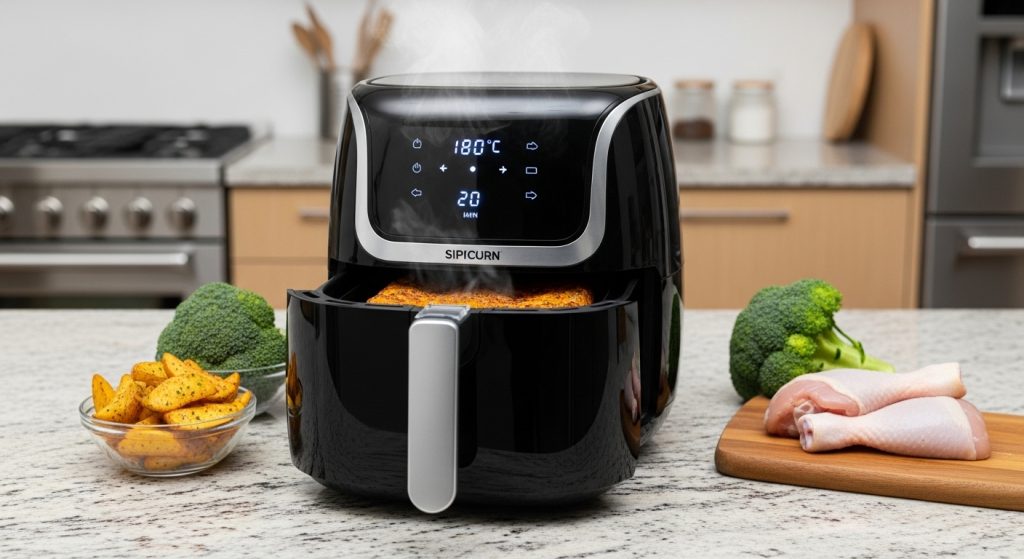
Pros and cons: Air Fryer (real-world)
✅ Air fryer advantages
1) Best crisp-per-minute
If your main goal is crisp food fast—fries, wings, nuggets, roasted veggies—air fryer wins. The airflow is aggressive, and the chamber is small, so it heats quickly and browns efficiently.
2) Fast preheat (often basically none)
In practice, I’m cooking within minutes. That alone makes it feel like it replaces the microwave for “reheat but not soggy” situations.
3) Easy for small batches
For 1–2 people, it’s perfect. You’re not heating a large box of air, so it feels efficient.
4) Less heat dumped into the kitchen
In hot climates or small apartments, this matters more than people think.
❌ Air fryer drawbacks
1) Limited “flat space” and shape
Most air fryers are basket-style. A whole pizza slice situation, a casserole dish, or anything wide can be awkward. You can’t always lay food out without stacking.
2) Batch cooking is the pain point
Yes, you can cook a lot—but crisping works best in a single layer. If you’re feeding 3–5 people, you’ll end up doing rounds.
3) Some foods cook unevenly unless you shake/flip
Fries, veggies, and small pieces often need a toss mid-way.
4) Baking is possible, but not always ideal
You can bake small items, but the strong airflow can dry out delicate bakes or blow parchment around if you’re not careful.
Pros and cons: Convection Toaster Oven (real-world)
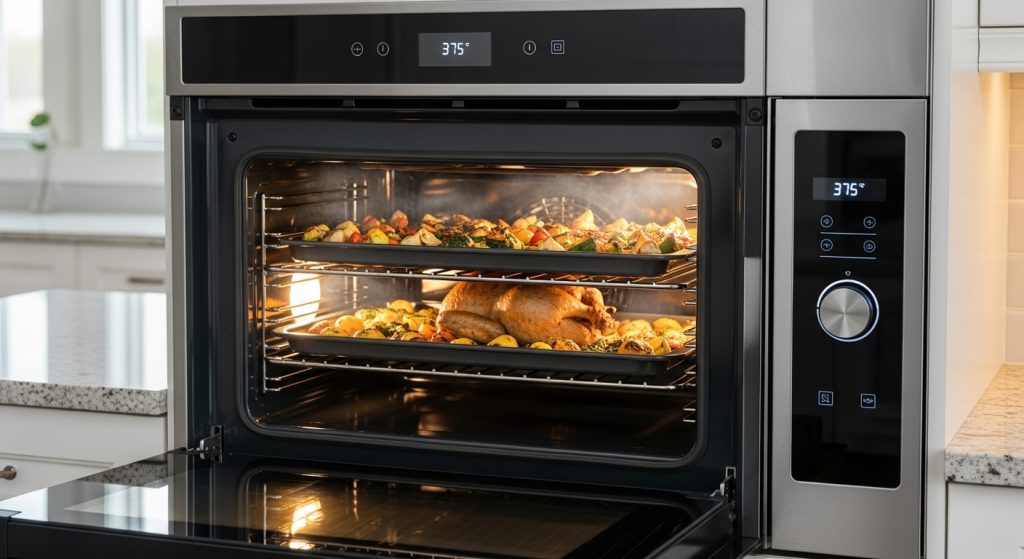
✅ Convection toaster oven advantages
1) Most versatile “mini oven”
Toast, bake, broil, roast, reheat—this is the closest thing to replacing a full-size oven for everyday tasks.
2) Better for multiple items and wider foods
You can use trays, pans, foil, ramekins, and bakeware more naturally. It handles:
- open-face melts
- sheet-pan style meals
- small casseroles
- cookies, biscuits, pizza slices
- fish fillets laid flat
3) More “real cooking” control
You usually get better temperature control, rack positions, and broil performance. It’s easier to do “finish under broil” to brown cheese or crisp tops.
4) Better for family-style portions
Even small toaster ovens tend to feel more spacious than basket air fryers for cooking in one go.
❌ Convection toaster oven drawbacks
1) Slower crisping
It can crisp, but usually not as aggressively as a dedicated air fryer. For fries and wings, it’s good—but not always “air fryer crunchy” unless you tweak time/placement.
2) Takes more counter space
This is often the deciding factor in small kitchens.
3) More parts to clean
Crumb tray, racks, pans—there’s usually more wiping and upkeep.
4) Preheat can matter more
Many models do better with a short preheat, especially for baking or crisping.
Head-to-head: Which one replaces more appliances?
Replaces microwave (for reheating)?
- Air fryer replaces the microwave more often for me because it makes leftovers crisp instead of rubbery.
- Toaster oven is also great for reheating pizza, pastries, and anything breaded—but it’s usually a bit slower.
Winner: Air fryer (for speed + crisp reheat)
Replaces toaster?
- Convection toaster oven is literally built for this job.
- Air fryer can toast bread in some setups, but it’s not as convenient or consistent.
Winner: Convection toaster oven
Replaces full-size oven?
- Convection toaster oven does this better overall—baking, broiling, roasting, “small-pan meals.”
- Air fryer can replace the oven for many things, but size/shape limits show up quickly.
Winner: Convection toaster oven
Replaces deep fryer (or gives that “fried” texture)?
- Air fryer is the clear winner for the closest thing to fried texture with less oil.
Winner: Air fryer
Replaces skillet/pan cooking?
Neither fully replaces a skillet for sautéing, sauces, or searing. But:
- Air fryer can handle quick proteins and veggies with minimal cleanup.
- Toaster oven can roast and broil more like oven-style cooking.
Winner: Tie (depends on your cooking style)
Real-life cooking scenarios (experience-based)
If you cook for 1–2 people
Air fryer feels like the daily driver. It’s quick, low-effort, and hits the “crispy and satisfying” button fast.
If you cook for 3+ people or meal prep
Convection toaster oven tends to replace more appliances because it handles larger trays, multiple servings, and wider foods without multiple batches.
If you eat lots of frozen convenience foods
Air fryer wins on speed and texture—especially anything breaded or “should be crispy.”
If you bake even occasionally
Toaster oven wins. Cookies, biscuits, reheating pastries, melting cheese, small casseroles—it’s simply easier.
If you hate cleanup
Air fryer basket cleanup is fast, but toaster ovens can be easy too if you use foil/liners smartly. The difference is that toaster ovens usually require more routine wiping.
The best choice depends on one question
Do you want a “crispy machine” or a “mini oven”?
Choose an air fryer if you want:
- fastest crisping and browning
- quick meals for 1–2 people
- better leftovers than a microwave
- minimal heat in the kitchen
- simple, repeatable results
Choose a convection toaster oven if you want:
- the most versatile replacement for a full oven
- real baking + broiling + roasting
- toast + reheat + “sheet-pan” cooking
- easier cooking for multiple people
- more flexibility with pans, trays, and wider foods
Optimal pick: Which one replaces more appliances?
For most kitchens—especially if you’re trying to replace multiple appliances—a convection toaster oven replaces more overall.
Why?
- It can be your toaster and mini oven and broiler and reheat station.
- It handles more food shapes and cooking styles without workarounds.
- It’s better for baking and “real meals,” not just crisping.
But—and this is important—if your primary goal is crispy results fast and you cook smaller portions, an air fryer will feel more useful day-to-day, even if it technically replaces fewer categories of appliances.
My practical recommendation (simple rule)
- Small kitchen + 1–2 people + you love crispy food: Air fryer
- You want one appliance to do the most jobs (toast + bake + broil + roast): Convection toaster oven ✅ optimal overall
- If you already own one: don’t “upgrade” unless you’re solving a specific frustration (batch size, baking, or crisp speed).
Tips to get the best results (no matter what you choose)
To make an air fryer work better
- Don’t overcrowd—single layer = crisp
- Shake/flip halfway for even browning
- Use a tiny bit of oil for better color and crunch
To make a convection toaster oven crisp better
- Use convection + higher rack position
- Preheat briefly for crisping tasks
- Finish with a short broil to brown tops (watch closely)