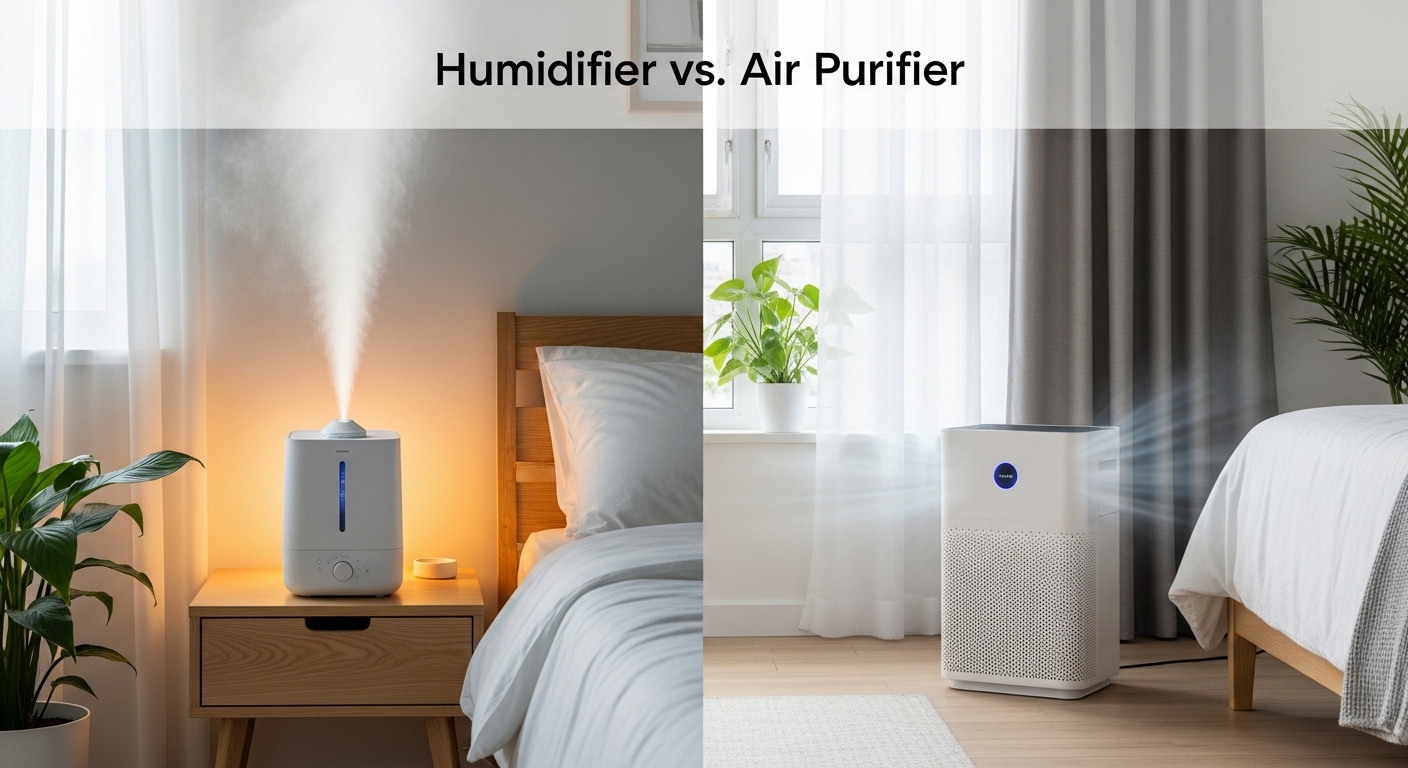
If you’re waking up with a dry throat, stuffy nose, or you just feel like your sleep is “lighter” than it should be, you’ve probably looked at humidifiers and air purifiers. They both claim comfort benefits—but they solve different problems.
Here’s the honest, practical breakdown of what each one actually helps with at night, how to choose based on symptoms, and what matters for real sleep improvement.
The core difference (in plain English)
- A humidifier adds moisture to the air.
- An air purifier removes particles from the air (dust, pollen, pet dander, smoke, etc.).
So the right choice depends on whether your sleep is disrupted by dryness or by irritants/allergens.
Signs you’ll sleep better with a humidifier
A humidifier helps most when the air is too dry—especially in winter, with strong A/C, or in naturally dry climates.
Common “dry air” sleep problems
- Waking up with dry mouth/throat
- Nose feels dry, crusty, or irritated
- Snoring that gets worse when air is dry
- Skin feels tight/itchy overnight
- Static shocks, dry eyes, scratchy voice in the morning
What it improves (realistically)
- Easier nasal breathing (less dryness irritation)
- Less throat irritation → fewer wake-ups
- Better comfort if you sleep with your mouth open
What it won’t fix
- Allergies from dust/pollen/pet dander
- Smoke odors
- Mold spores already in the room
- “I feel congested all the time” from allergens
Humidity target for sleep
Most people feel best around 40–50% relative humidity.
- Below ~30% often feels dry.
- Above ~55–60% can feel muggy and may increase dust mites or mold risk.
Signs you’ll sleep better with an air purifier
An air purifier helps most when your sleep is disrupted by allergens or airborne irritants.
Common “air quality” sleep problems
- Sneezing, itchy eyes, runny nose at night/morning
- Congestion that gets worse in bed or when the fan runs
- Pet hair/dander issues
- You live near traffic, smoke, or dusty conditions
- You notice your room smells stale or “heavy” (not always, but sometimes)
What it improves (realistically)
- Reduced airborne allergens → less congestion and irritation
- Less dust settling around the bed (especially with consistent use)
- Better sleep continuity if allergies are waking you up
What it won’t fix
- Dry throat from low humidity
- Snoring caused mainly by dryness
- Odors that are embedded in fabrics (it helps air, not your couch)
- Structural issues (mold source, leaks, dirty HVAC) without addressing the cause
Which one helps sleep more for most people?
If we’re talking “most common real-life sleep problems,” the winner depends on your symptoms:
If you wake up dry
✅ Humidifier is more likely to help immediately.
If you wake up congested/sneezy
✅ Air purifier is more likely to help.
If you’re not sure
This quick self-test helps:
Ask yourself:
- Do I feel worse when the heat/AC runs all night? → points to humidifier
- Do I feel worse in bed than on the couch? → points to air purifier (dust mites/pet dander)
- Do I improve after changing sheets or cleaning? → points to air purifier
- Do I improve after a hot shower/steam? → points to humidifier
My experience-based take (what actually changes sleep)
Humidifiers feel like comfort
When you need one, you feel it fast: throat less scratchy, nose less irritated, breathing feels smoother.
Air purifiers feel like fewer “micro-wakeups”
The effect can be subtler but real: less congestion, fewer allergy symptoms, less “I can’t breathe through my nose” in the middle of the night—especially after a few days of consistent use.
Downsides you should know (honest stuff)
Humidifier downsides
- If you don’t clean it, it can grow bacteria/mold (gross but true).
- Too much humidity can worsen:
- dust mites
- mold risk
- that “heavy/muggy” feeling
Real rule: If you won’t maintain it, don’t run it.
Air purifier downsides
- Some units have noticeable fan noise (which can be good or bad).
- Filters need replacing to stay effective.
- It won’t help if the main issue is dryness.
Optimal choice: what should you buy for better sleep?
Here’s the simplest decision rule:
✅ Choose a humidifier if your #1 problem is:
Dry throat, dry nose, dry air discomfort, winter heating dryness, snoring that worsens in dry air.
✅ Choose an air purifier if your #1 problem is:
Allergies, pet dander, dust sensitivity, congestion in bed, smoke/urban air issues.
✅ The “best overall” for sleep improvement (for many households)
If you have allergies or pets, an air purifier usually delivers the most consistent sleep benefit because it targets a common sleep disruptor: nasal congestion.
But if you’re in a dry environment and wake up with a dry throat regularly, a humidifier can be the fastest, most noticeable fix.
Best setup if you want to maximize sleep quality
If you can only do one thing besides buying a device:
- Wash bedding weekly in warm/hot water (as fabric allows)
- Vacuum around bed edges
- Keep humidity around 40–50%
- Keep pets off the pillow/bed if allergies are a problem
If you ever end up using both:
- Run purifier on low all night
- Run humidifier only to maintain 40–50% (not a swamp)